
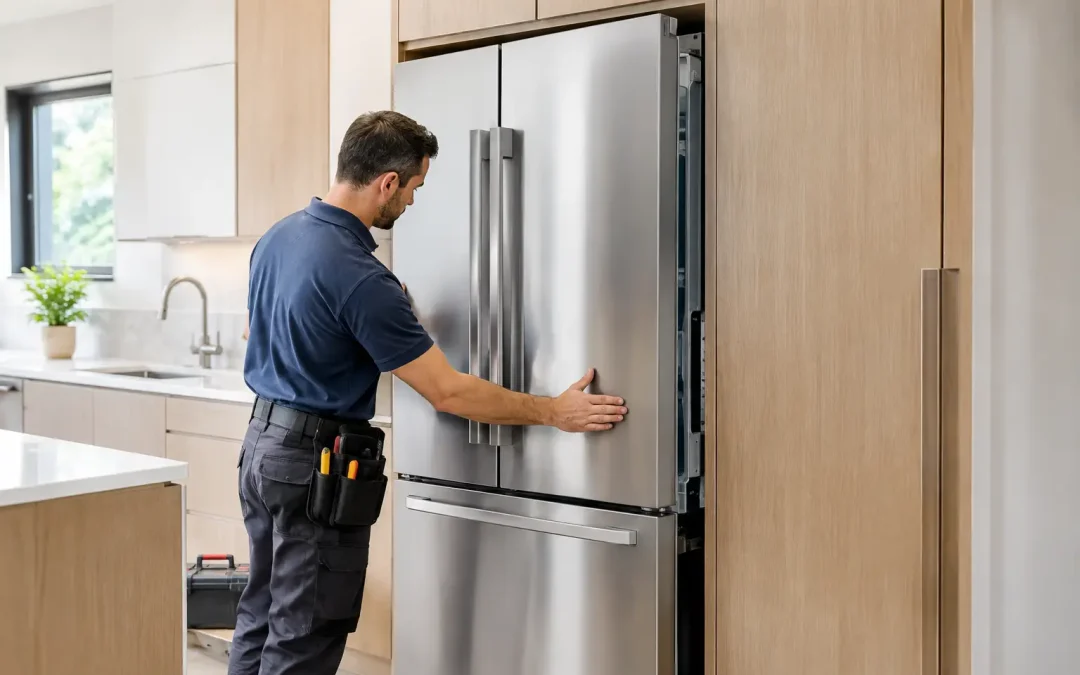
A built-in refrigerator can look perfectly aligned on installation day and still be set up for poor performance if the cabinet opening, ventilation path, electrical supply, or water line is wrong. Refrigerator installation for a premium system is not simply a matter of moving an appliance into place. It is the final technical step that protects a major kitchen investment and allows the unit to perform as its manufacturer intended.
Sub-Zero, Viking, GE Monogram, KitchenAid, Traulsen, Marvel, and other high-end refrigeration systems have distinct requirements. An installation that appears similar from the outside may involve different panel tolerances, hinge clearances, anti-tip provisions, drain arrangements, and ventilation specifications. That is why experience with built-in refrigeration matters before the appliance enters the opening.
Why Built-In Refrigerator Installation Is Different
A freestanding refrigerator is designed to sit in a room with clearance around it. A built-in unit is designed as part of the architecture of the kitchen. It often sits flush with cabinetry, accepts custom panels, and relies on a defined path of airflow through a grille, toe kick, or other engineered vent area.
That distinction has practical consequences. When ventilation is restricted, the compressor system may run longer and cabinet temperatures can become inconsistent. When the unit is not level, doors may not self-close correctly, drawers may not operate as intended, and the reveal around custom panels can look uneven. A water connection that is accessible but poorly selected can create risk behind finished cabinetry.
The appliance also has to be protected during delivery and positioning. Premium built-in refrigerators are heavy, precisely finished, and often installed near stone flooring, millwork, islands, and painted walls. Careful handling is part of the work, not an optional extra.
Start With the Opening, Not the Appliance
The most successful installations are planned while cabinetry and utilities can still be adjusted. A refrigerator should never be ordered solely because its listed width appears to match the width of a cabinet opening. Manufacturer dimensions, required clearances, panel thickness, hinge movement, and surrounding trim all affect the final fit.
For integrated and overlay-panel models, the cabinetry must account for the door panels as well as the refrigeration unit. A panel that is too thick, too heavy, or mounted out of position can interfere with adjacent cabinets, prevent full door opening, or place unnecessary stress on hinges. The issue may not be apparent until the final adjustment stage, when correcting it becomes more involved.
Depth deserves equal attention. Some units are intended to sit nearly flush with cabinet faces, while others are designed for a particular projection. Countertop overhangs, handles, decorative panels, and nearby islands can all affect door swing. In a narrow kitchen, even a small clearance error can limit access to drawers, crisper compartments, or a fully loaded freezer.
Confirm These Requirements Before Delivery
Before refrigerator installation is scheduled, the installer should be able to verify the appliance model and site conditions, including:
- Finished opening width, height, and depth
- Required top, bottom, and front ventilation areas
- Dedicated electrical outlet location and voltage requirements
- Water supply location, shutoff access, and line condition
- Floor strength, levelness, and finished-floor transitions
- Door swing, panel dimensions, and nearby cabinet clearance
This review is especially valuable after a renovation. A kitchen may look complete while a water valve is trapped behind the appliance, an outlet is positioned where it will be crushed, or a decorative grille has reduced the airflow the unit requires. Identifying those details before delivery is less disruptive than discovering them with a refrigerator in the hallway.
Utilities Need to Be Accessible and Correct
Built-in refrigeration depends on reliable utility connections. Electrical work should meet the appliance manufacturer’s specifications and local code requirements. The outlet must be placed where it remains protected and accessible, without preventing the unit from sliding into its correct position.
For models with ice makers or water dispensers, the supply line requires the same consideration. A quality shutoff valve should be reachable without removing cabinetry or pulling the refrigerator forward. The line should be routed to avoid kinking, abrasion, and pressure points behind the unit. If a homeowner has experienced discolored ice, slow production, or leaks at a previous refrigerator, the water connection deserves careful evaluation rather than a quick reuse of an aging line.
Not every installation has the same plumbing needs. A refrigerator with an internal ice maker differs from a dedicated ice machine, and wine storage units may have no water connection at all. Some specialty systems also have drainage requirements. The right approach depends on the specific appliance, which is one reason model-specific expertise is so valuable.
Leveling Is a Performance Detail, Not a Cosmetic Detail
Once the unit is positioned, leveling and anchoring determine how it operates over time. Built-in refrigerators are typically adjusted at the front and rear to create the manufacturer-specified stance. This supports proper door movement, drawer travel, drainage, and alignment with adjoining cabinetry.
A unit can be visually close to level yet still have a door that slowly drifts open or fails to close with the correct action. On a panel-ready model, uneven leveling can also make an otherwise well-made kitchen look misaligned. The objective is not merely a straight line across the top. It is a stable, properly supported appliance with doors and drawers that operate correctly under normal daily use.
Anti-tip brackets or other retention methods are equally significant. These systems help prevent movement when loaded doors or drawers are extended. Skipping this step can affect both safety and long-term alignment, particularly in homes with active kitchens, children, or heavy custom door panels.
Custom Panels Require Exact Adjustment
Panel-ready refrigeration is where installation becomes particularly visible. A small variation in panel position can create an uneven gap between doors, a mismatch with surrounding drawers, or interference at the hinge side. The panels must be secured to the appropriate specifications, but they also need to be adjusted as part of the completed kitchen composition.
Weight is a consideration as well. Decorative panels made from solid wood, specialty veneers, or layered materials can be substantial. The unit’s published panel limits and hardware instructions should guide the design. A panel that looks appropriate in a drawing may be unsuitable once material thickness, hardware, and finish are calculated.
Experienced service specialists also consider what happens after installation. Can the grille be removed for service? Can the water filter be changed? Is there sufficient clearance to access key components if maintenance is needed? Good refrigerator installation protects the appearance of the kitchen without making future care unnecessarily difficult.
Commissioning Verifies More Than Cold Air
After positioning and connections are complete, the system should be checked carefully. Doors, drawers, lighting, controls, alarms, ice-maker operation where applicable, and water connections all deserve review. Depending on the appliance, the installer may need to confirm that a unit has begun its proper cooling cycle and that there are no unusual noises, error indicators, or signs of a restricted airflow path.
Temperature stabilization takes time. Loading a newly installed refrigerator immediately with large quantities of room-temperature food can slow the pull-down period and make it harder to judge early performance. Allowing the unit to reach and maintain its target temperature first gives the refrigeration system a fair start.
Homeowners should also keep the model and serial information available, along with any care instructions and warranty documentation. Factory-certified installation and service practices can be meaningful to warranty protection, particularly for sophisticated built-in equipment. If a concern develops later, accurate model information helps a specialist identify the right technical specifications and parts.
When Specialized Installation Service Makes Sense
Some installations are straightforward, but others merit a refrigeration specialist from the beginning. This is particularly true for a new Sub-Zero built-in system, an integrated column refrigerator or freezer, a panel-ready kitchen renovation, a wine storage unit, or a replacement where the new appliance must fit existing cabinetry.
Specialized help is also worthwhile when a prior unit had chronic cooling concerns, repeated ice-maker issues, cabinet condensation, damaged floors, or doors that never aligned properly. Those symptoms may stem from the appliance, but they can also point to installation conditions that were overlooked.
For New Jersey homeowners with premium refrigeration, Fridge Fix brings factory-certified, brand-focused experience to installation and ongoing service. The goal is to place the appliance correctly, respect the finished home, and establish conditions that support reliable operation for years rather than simply getting the unit turned on.
A premium refrigerator earns its place in the kitchen over thousands of door openings, grocery trips, dinner parties, and quiet mornings. Giving its installation the same level of care as the cabinetry, stone, and lighting is one of the clearest ways to protect that investment from day one.