
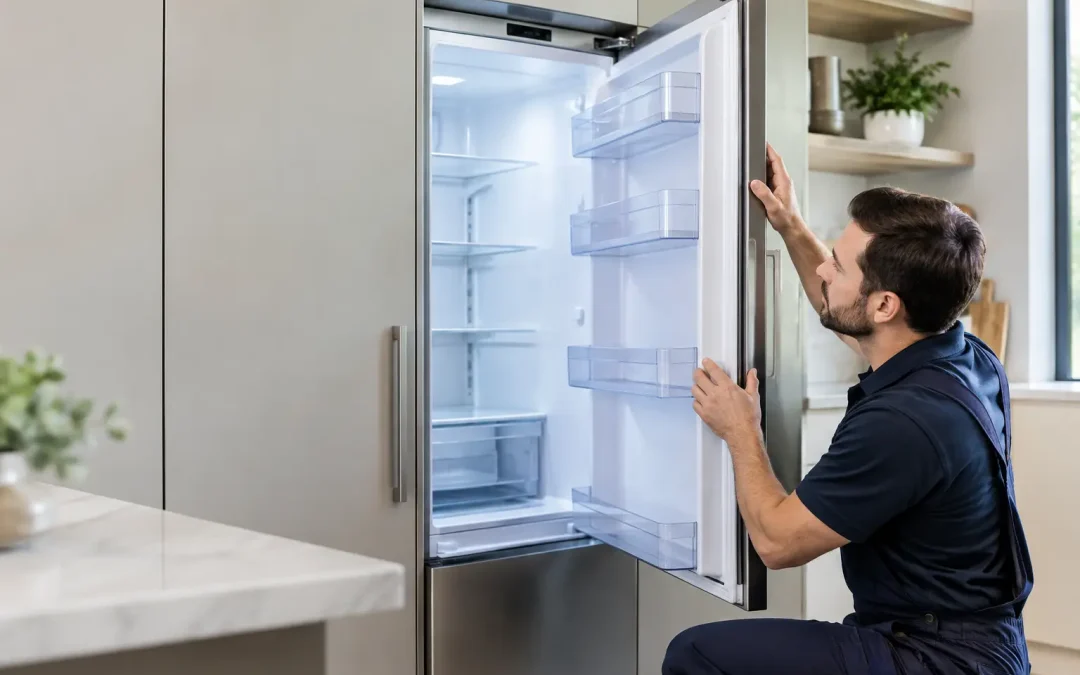
A refrigerator door that needs an extra push, pops open after closing, or triggers an intermittent alarm is not a minor annoyance in a premium built-in kitchen. Effective refrigerator door troubleshooting begins with the door itself, but it should also account for panel weight, cabinet alignment, loaded shelves, and the appliance’s electronic door-switch system. On a Sub-Zero, Viking, GE Monogram, or other high-end built-in unit, a small closure issue can affect temperature stability, compressor run time, food preservation, and surrounding cabinetry.
Before making adjustments, observe the problem rather than forcing the door shut. Does it occur every time or only when the refrigerator is fully stocked? Is one corner sitting proud of the frame? Does the door close normally until the final inch? Those details help distinguish a simple obstruction from a hinge, gasket, leveling, or control-related concern.
Start Refrigerator Door Troubleshooting With the Simple Checks
Open the door and inspect the path between the door and the cabinet. Containers, pull-out bins, oversized bottles, and a shelf that has shifted forward can prevent complete closure. On a built-in refrigerator, this can be surprisingly subtle: the door may appear closed from across the room while a drawer or tall bottle holds it open just enough to compromise the seal.
Then look at the gasket, also called the door seal. It should sit evenly against the cabinet frame all the way around, without folds, tears, hardened sections, or food residue. Wipe it with a soft cloth, warm water, and mild dish soap, then dry it thoroughly. Avoid harsh solvents, abrasive pads, or petroleum-based cleaners. They can damage the gasket material or leave a residue that interferes with its grip.
A quick paper test can be useful. Close the door on a strip of ordinary paper at several points around the perimeter. You should feel consistent resistance when pulling it out. A loose result at one location does not automatically mean the entire gasket needs replacement, but repeated weak spots deserve professional attention.
Also check whether the appliance is level and properly supported. Built-in refrigeration is designed to sit precisely within its opening. If flooring has settled, cabinetry has been altered, or leveling legs have shifted, the door may no longer swing and settle as intended. Do not assume a refrigerator should lean backward or forward based on general appliance advice. Premium built-in systems have model-specific installation requirements, and an incorrect adjustment can create panel gaps, stress hinges, or affect drawer operation.
What the Door’s Behavior Usually Tells You
The pattern matters. A door that will not stay closed has a different likely cause than one that closes but develops condensation. Use these symptoms as a guide, not as a reason to disassemble a high-value appliance.
- The door rebounds open: An item may be blocking closure, the refrigerator may be out of level, or the gasket may be catching or compressed.
- One side of the door sits lower: Hinge wear, loose mounting hardware, an improperly supported custom panel, or cabinet movement may be involved.
- There is frost or moisture near one section of the opening: The gasket may not be sealing evenly, or the door may be slightly misaligned.
- The interior light stays on or a door alarm sounds: The door switch, magnet, alignment, or control system may not be registering a fully closed door.
- The door is difficult to open immediately after closing: This can be normal pressure equalization, particularly when the appliance is cooling actively. It should ease after a short wait and should not require excessive force.
Built-in doors are often heavier than standard refrigerator doors, especially when fitted with custom wood panels or stainless steel panels. That added weight makes hinge alignment more consequential. A small sag can become noticeable at the top corner first, where the gasket no longer meets the frame evenly.
Gasket Problems Are Not Always Gasket Failures
A gasket is flexible, but it is not indestructible. Age, repeated contact with spills, and a door held open for extended periods can leave it distorted. Yet an apparent seal problem may originate elsewhere. If the door has shifted on its hinges, installing a new gasket without correcting alignment may leave the same gap in place.
Look for a gasket that is pulled out of its retaining channel, creased at a corner, or visibly torn. Lightly pressing a displaced section back into position may be appropriate if it slips back into its intended channel without force. If the gasket is brittle, swollen, or repeatedly comes loose, stop there. The correct replacement must match the model and door configuration, and installation should be performed carefully to avoid damaging the liner or door structure.
Condensation on the exterior of the cabinet or moisture around the opening should be treated promptly. It can indicate warm air intrusion, but it may also reflect unusually humid room conditions. A technician can determine whether the issue is limited to the seal or connected to airflow, defrost performance, or cabinet insulation.
Hinges, Panels, and Alignment Require a Careful Approach
Do not tighten every visible screw in an attempt to correct a sagging door. On integrated and built-in refrigeration, hinge hardware, door-panel mounting points, and adjustment screws have specific functions. Random adjustment can shift the reveal between doors, cause a panel to rub against cabinetry, or place uneven load on the hinges.
A useful visual check is to stand several feet back and compare the gaps around the door. On French-door models, compare the space between the two doors from top to bottom. On column refrigeration, compare the door edge to the cabinet opening and adjacent panels. Uneven gaps, rubbing, or a door that closes only when lifted are strong indicators that the unit should be evaluated by a qualified specialist.
This is especially true after kitchen renovations. New flooring, changed cabinet faces, door-panel replacement, or moving the appliance for service can affect final alignment. The refrigerator may still cool, but a poorly aligned door can gradually increase energy use and create wear that is more expensive to correct later.
When a Door Alarm Does Not Match What You See
If the door looks closed but the appliance reports an open door, avoid assuming the alarm is faulty. First, confirm that the gasket is making contact and that no drawer or bin is in the way. Clean any visible debris from the door-switch area without spraying cleaner directly into switches or openings.
Many premium refrigerators use switches, magnets, or sensors to tell the control system when the door is closed. A misaligned door can keep that system from registering properly. Less commonly, the switch, wiring, or electronic control may require diagnosis. Repeated alarms can lead to warmer cabinet temperatures and unnecessarily long run times, so they should not be ignored simply because the door appears closed.
If food is warming, the interior light remains on, or the unit is alarming continuously, move perishable items to a reliable cold location while service is arranged. Do not block vents or lower temperature settings aggressively to compensate. That can mask the underlying condition and may create uneven temperatures elsewhere in the compartment.
When to Schedule Professional Service
Homeowners can safely remove obstructions, clean the gasket, and document the symptoms. Beyond that, repair decisions depend on the appliance’s model, age, configuration, and installation. Built-in units often require controlled access, special care around finished panels, and model-specific parts. The trade-off is clear: a do-it-yourself hinge adjustment may seem economical, but damage to a custom panel, hinge assembly, or cabinet surround can quickly outweigh the cost of qualified service.
Schedule service when the door is sagging, rubbing, failing the paper test at multiple points, showing a torn gasket, or causing recurring alarms, frost, moisture, or temperature changes. A factory-qualified technician can assess the door relationship to the cabinet, verify hinge condition, inspect the seal, and determine whether adjustment, replacement parts, or a broader cooling-system diagnosis is needed.
For New Jersey owners of premium built-in refrigeration, Fridge Fix brings factory-certified, brand-specific experience to door and sealing concerns that deserve more than a generic appliance repair approach. A properly aligned, fully sealed refrigerator door protects the appliance’s performance and the kitchen investment around it.