
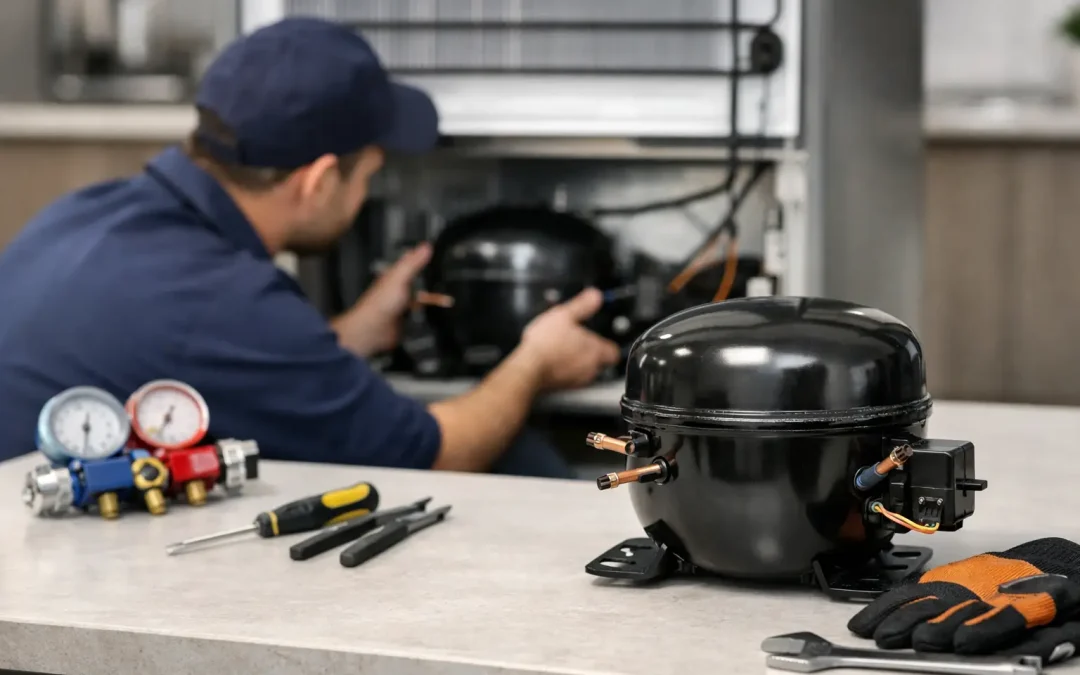
A refrigerator that runs warm, clicks repeatedly, or suddenly stops cooling can make refrigerator compressor replacement seem like the obvious answer. For a premium built-in unit, however, the compressor is only one part of a carefully engineered refrigeration system. A precise diagnosis should come before a major repair decision, especially when the appliance is integrated into custom cabinetry and protects a substantial food or wine investment.
What the Compressor Does in a Built-In Refrigerator
The compressor is the engine of the sealed refrigeration system. It pressurizes refrigerant and moves it through the condenser, evaporator, and connecting lines so the unit can remove heat from its compartments. When it operates correctly, temperatures remain stable, food stays protected, ice production is consistent, and a wine storage unit can maintain its intended environment.
Built-in refrigeration places particular demands on this system. A Sub-Zero, Viking, GE Monogram, or similar premium appliance may use separate cooling zones, specialized controls, variable-speed components, or dual-compressor configurations. The compressor may serve one compartment while another remains functional. That detail matters because partial cooling does not automatically identify the failed component.
A compressor failure can be serious, but it is not the only reason a refrigerator may be warm or noisy. Control-board issues, condenser airflow restrictions, failed fans, defective start components, sensor faults, refrigerant leaks, and evaporator problems can create similar symptoms. Replacing a compressor without confirming the underlying cause can mean unnecessary expense and continued performance problems.
Signs That Require a Professional Diagnosis
A compressor does not usually fail without warning, although the signs may be easy to mistake for a routine issue. Persistent clicking or humming from the machine compartment, unusually high temperatures, frequent cycling, and an inability to recover after doors have been opened are all reasons to schedule service.
A compressor that is extremely hot to the touch, paired with poor cooling, also deserves attention. So does a refrigerator that trips a breaker, makes a brief start attempt before shutting down, or has one compartment warm while another seems normal. In a dual-compressor system, isolated temperature loss can help narrow the diagnosis, but only testing can confirm it.
Before assuming the worst, a qualified technician will inspect condenser cleanliness and airflow, verify the condition of fans, evaluate electrical supply, test relays and overload devices, review fault codes where applicable, and take system pressure and temperature readings. These steps distinguish a failed compressor from a less extensive repair.
For a built-in refrigerator, access is part of the diagnostic work. Units installed flush with cabinetry can require careful removal to reach the mechanical compartment without damaging flooring, panels, trim, or surrounding millwork. This is not a job for a general repair approach based on guesswork.
Refrigerator Compressor Replacement Is a Sealed-System Repair
Compressor replacement is more involved than swapping a visible appliance part. The technician must safely recover refrigerant, remove the failed compressor, install the correct replacement component, replace supporting sealed-system materials as required, braze connections, pressure-test the system, evacuate moisture and air with a vacuum pump, recharge the system to specification, and verify operating performance.
The quality of each stage affects the life of the repair. A small leak, contamination inside the system, an incorrect refrigerant charge, or an overlooked cause of compressor failure can compromise cooling and shorten the life of the new component. Refrigerant handling also requires the appropriate certification and equipment.
On premium appliances, correct parts selection is equally important. Compressors are not interchangeable simply because they fit physically. Capacity, electrical characteristics, refrigerant type, control compatibility, and the model’s original engineering specifications all need to align. Factory-trained experience is especially valuable when the refrigerator has brand-specific diagnostics or a complex dual-system design.
After the repair, the unit needs time to stabilize. A technician should confirm that temperatures pull down properly, fans and controls operate as expected, and no abnormal noise, vibration, or frost pattern suggests an unresolved system issue. The work is complete when the refrigeration system performs reliably, not merely when the compressor starts.
Repair or Replacement: How to Make the Decision
The right choice depends on more than the age of the refrigerator. Premium built-in systems are designed for long service lives, and a compressor repair can be a sensible investment when the cabinet, doors, insulation, controls, and other major components remain in good condition. Replacing an integrated refrigerator can also involve cabinet modifications, panel work, delivery coordination, and disruption to a finished kitchen.
Still, refrigerator compressor replacement is not always the best path. If an older unit has multiple costly failures, significant corrosion, obsolete parts concerns, or a sealed-system issue caused by a larger defect, replacement may offer better long-term value. A unit with repeated cooling failures deserves a broader evaluation rather than another isolated repair.
The decision should account for the appliance’s model, condition, repair history, expected parts availability, warranty coverage, and the cost of replacement installation. Homeowners should also consider what the refrigerator protects. A wine cooler serving a valuable collection, for example, may justify a faster and more specialized response than a standard secondary refrigerator.
A clear service recommendation should explain the diagnosis, the scope of repair, expected performance, and practical alternatives. The goal is not to push a replacement part. It is to protect the appliance investment and help the homeowner make an informed decision.
Questions to Ask Before Approving a Compressor Repair
Ask whether testing confirmed compressor failure or whether another component could be responsible. It is also reasonable to ask what caused the failure, whether the correct manufacturer-specified compressor is available, and what related sealed-system parts will be replaced during the repair.
For built-in equipment, ask how the unit will be moved and reinstalled safely. The answer should include attention to finished floors, custom panels, ventilation clearances, and cabinetry. If the refrigerator is still covered by a manufacturer or extended warranty, confirm how the repair may affect that coverage.
Finally, ask what performance checks will be completed after installation. Stable temperatures, appropriate cycling, proper airflow, and a verified sealed system provide more meaningful assurance than hearing the compressor turn on once.
Protecting the New Compressor
A new compressor benefits from the same conditions that help the original system last. Keep condenser areas clean and maintain the ventilation clearances required for the appliance. Built-in refrigerators reject considerable heat, and restricted airflow makes the entire system work harder.
Routine preventive maintenance can reveal dirty condensers, worn fan motors, drain concerns, door-seal issues, and developing temperature irregularities before they place added strain on the refrigeration system. This is particularly worthwhile for appliances that operate continuously in busy family kitchens, vacation homes, or entertainment areas.
Avoid blocking vents with stored items and address temperature alarms promptly. A refrigerator that seems to be cooling adequately while running almost nonstop may be compensating for an issue that will become more expensive over time. For wine storage, verify temperatures independently if you notice frequent cycling or unexpected fluctuations.
Specialized Service for High-Value Refrigeration
Premium built-in refrigeration deserves a specialist who understands both the sealed system and the installation around it. Fridge Fix provides factory-certified, brand-focused service for sophisticated refrigeration equipment, with the care required for appliances that are central to a finished kitchen.
If your refrigerator is warm, noisy, or showing repeated cooling problems, preserve food safely and arrange a professional diagnosis before authorizing a compressor. A well-supported repair begins with finding the real fault and ends with dependable temperatures you do not have to think about.